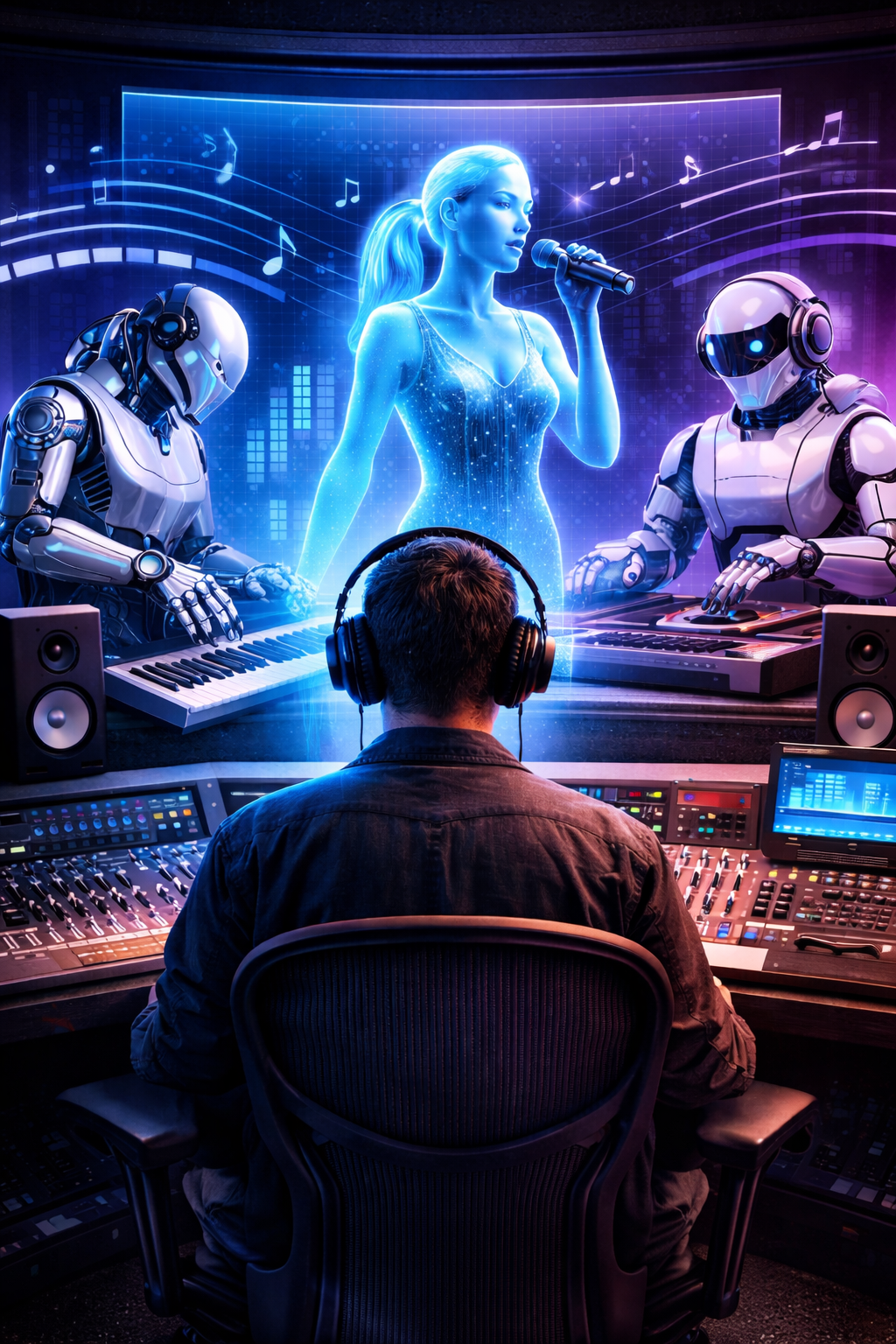
For decades, the music industry has navigated digital disruptions—from the MP3, the shift away from large production studios to the streaming revolution. However, 2025 has brought a new evolution: Generative Artificial Intelligence (AI). AI is no longer a futuristic concept. It has become a foundational element of the music industry, fundamentally reshaping how music is created, promoted, and safeguarded in ways unforeseen just a couple of years ago.
Today, Artificial intelligence (AI) is rapidly transforming the music industry, reshaping how music is produced, distributed, monetized, and regulated. From AI-generated compositions and virtual artists to data-driven marketing and automated production tools, the technology is no longer experimental—it is structural. While AI offers efficiency and expanded creative avenues, it also raises significant questions about power, labor, culture, and law. These tensions are particularly evident in the contrasting experiences of independent artists and major labels, the evolution of musical genres, and the future of creative work itself.
Independent Artists vs. Major Labels
AI has the potential to level the playing field for independent artists, yet it may also deepen existing disparities. On one hand, AI-powered tools for composition, mixing, mastering, and marketing significantly reduce the costs of creating professional-quality music. Independent musicians now have access to capabilities that were once exclusive to expensive studios, engineering teams, and label support. Recommendation algorithms and social platforms further enable artists to reach global audiences without traditional gatekeepers.
Conversely, major labels are uniquely positioned to leverage AI at scale. With extensive catalogs, proprietary listener data, and legal resources, labels can train AI models on decades of recorded music, optimize release strategies, and even produce AI-generated content that competes directly with human artists. There is a growing concern that AI could flood streaming platforms with low-cost, algorithm-friendly music, potentially diminishing visibility and revenue for independent creators. While AI reduces entry barriers, it does not automatically redistribute power.
Independent artists are discovering that access does not guarantee attention. AI has significantly accelerated the supply chain, leading streaming platforms to be inundated with new releases, many of which are partially or fully machine-generated. Consequently, visibility has become the industry’s primary bottleneck. Independent artists increasingly rely on recommendation systems to determine who gets heard and who fades into the background.
Major labels have embraced AI aggressively, using data to inform signing decisions, marketing investments, and release strategies. Predictive analytics mitigate risks, while automated production tools help labels monetize catalogs more efficiently, especially in functional contexts like gaming, film, and background music.
Implications for Genre and Creativity
AI’s impact on sound is subtle yet pervasive. Systems trained on popular music tend to favor familiarity, reinforcing established genre norms. Recommendation engines reward music that aligns with known patterns, raising concerns about creative homogenization. At the same time, artists are using AI to blur boundaries—mixing styles, reviving old forms, reimagining classic hits in different genres, and exploring uncharted musical territories. New hybrid genres are emerging from human-machine collaborations, complicating notions of authorship and originality.
By analyzing vast datasets spanning styles, eras, and cultures, AI systems can generate compositions that blend genres in unprecedented ways. This has led to the emergence of novel sounds, from AI-assisted jazz improvisations to synthetic pop vocals trained on stylistic archetypes rather than individual artists.
However, this raises fundamental questions about creativity and authorship. When AI recombines existing musical patterns, critics argue it risks reinforcing uniformity rather than innovation, prioritizing statistically popular structures over cultural or emotional depth. Others view AI as a collaborative tool—an extension of human creativity rather than a substitute. Similar to synthesizers and sampling before it, AI may become another instrument, shaping genres while still relying on human intent to imbue music with meaning.
Structure and Labor
The adoption of AI is already transforming labor across the music industry. Roles such as session musicians, audio engineers, composers for commercial music, and background-score writers face increasing automation. AI software like SUNO Studio can generate royalty-free music for advertising, gaming, and social media at a fraction of the cost and time. AI could also expedite the industry’s shift toward platform dominance, enabling streaming services, social networks, and AI tool providers to control the industry’s economic landscape. Their access to data on listener behavior, music consumption patterns, and artist preferences will become a crucial asset.
Simultaneously, new roles are emerging. Prompt designers, AI music supervisors, data analysts, and hybrid artist-technologists are becoming integral parts of the industry ecosystem. The challenge lies in managing this transition. Without safeguards, AI-driven efficiency could prioritize profits while diminishing opportunities for human workers. The industry faces a familiar dilemma—technological advancement without equitable labor adaptation risks long-term instability.
Cultural Implications
Music is not merely an industry; it is a cultural artifact. AI-generated music complicates notions of authenticity, identity, and emotional connection. When listeners struggle to differentiate between human-made and machine-generated music, questions arise about what we value in art: technical precision, emotional expression, or lived experience.
Bias remains a significant concern. AI trained on commercially dominant catalogs risks marginalizing underrepresented voices. There are also worries about cultural appropriation and standardization. AI models primarily trained on Western or commercially dominant music may marginalize less-documented traditions, reinforcing cultural hierarchies. Conversely, when used responsibly, AI could aid in preserving endangered musical styles by analyzing and recreating them for future generations. The cultural impact of AI in music will largely depend on whose data is utilized, who controls the tools, and whose voices are amplified.
Legal and Regulatory Challenges
Over the years, the legal framework surrounding music has struggled to keep pace with technology, and AI has only compounded the challenge. Copyright law is rooted in human authorship, leaving ambiguity around AI-generated works. Key questions remain unresolved: Who owns music created by an AI model? Are artists entitled to compensation if their work is used to train those models? Can an AI-generated voice that mimics a real singer constitute infringement?
Regulators worldwide are beginning to address these issues, but progress is uneven. Some jurisdictions are exploring transparency requirements for training data and labeling of AI-generated content, while others rely on existing copyright doctrines that were never designed for machine creativity. Without clear regulation, the risk of exploitation—particularly of independent artists—remains high.
Conclusion
AI is not displacing music production; it is redefining it. For artists, it offers unparalleled creative leverage in an era of intense competition. For labels and platforms, it delivers efficiency and reshapes power dynamics. AI is neither a savior nor a villain for the music industry; it is a force multiplier. It can empower independent artists, expand creative horizons, and enhance efficiency—but it can also entrench power differentials, disrupt labor markets, and challenge cultural and legal norms. The impact of AI will ultimately be shaped not by the technology itself, but by the policies, business models, and ethical decisions that govern its use. As the music industry enters this new era, the central question is not whether AI will transform music, but whether it will do so in a manner that remains rooted in human creativity. See the attached YouTube discussion from Bloomberg Tech: Europe (1/9/2026) for additional perspective – https://youtu.be/h4rjoItWbb8?si=9S2UalvP8ppqVOnA